
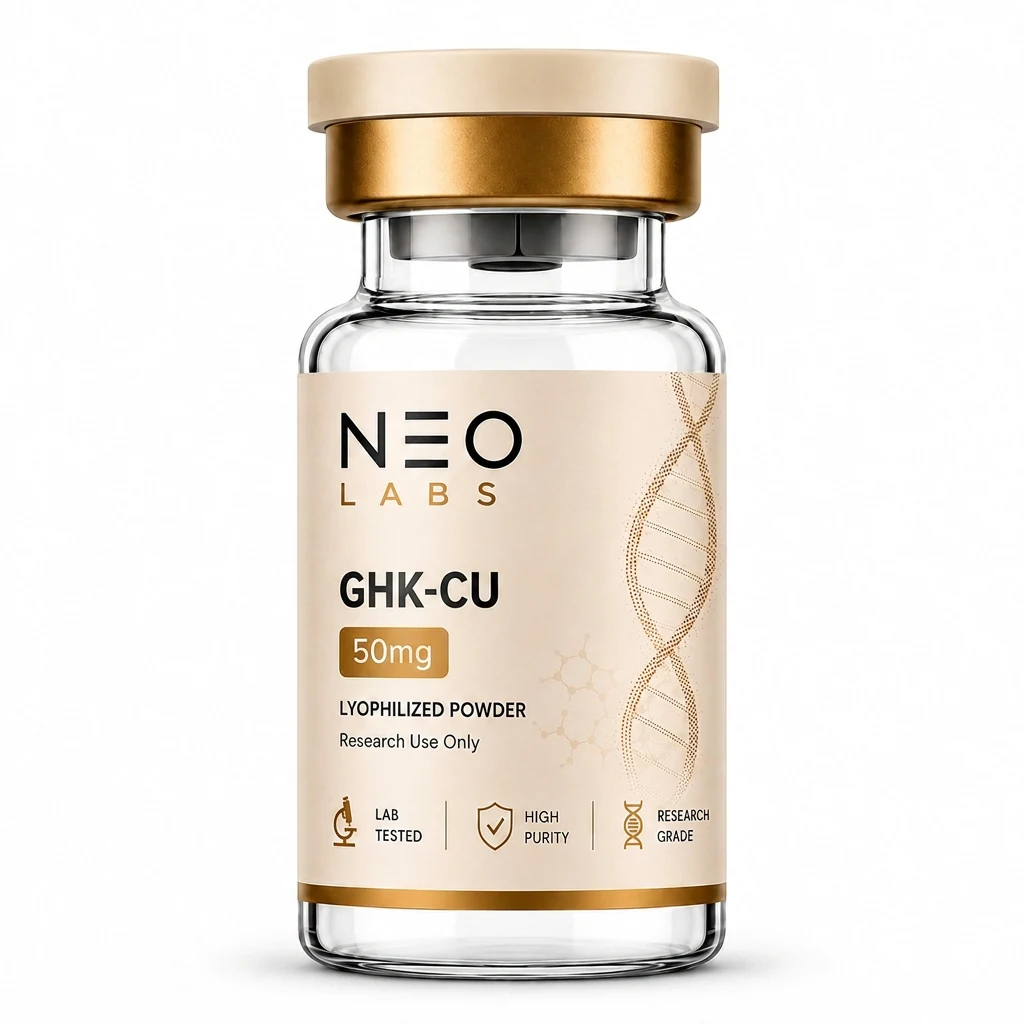
How is GHK-Cu classified?
A metallopeptide: a short peptide defined by its bound metal ion. Reported plasma GHK concentrations decline with age, which is the framing most reviews use when introducing it.
How is its mechanism studied?
- Copper ion transport and delivery to cells in binding-affinity studies.
- Extracellular-matrix gene expression, including collagen and glycosaminoglycan synthesis in fibroblast models.
- Broad gene-expression profiling, where published microarray work reports modulation across large gene sets.
What kind of research exists?
Decades of in vitro and tissue-model work, plus dermatological formulation studies. Much of the applied literature concerns topical preparations rather than systemic study designs — a distinction worth keeping in view when reading results.
What is it studied alongside?
AHK-Cu and other copper peptides, and in repair-model reviews alongside BPC-157 and KPV.
How does Neo Labs supply and handle it?
Supplied lyophilised with characteristic blue colouration, third-party tested with a batch COA. Cold, dark storage.