
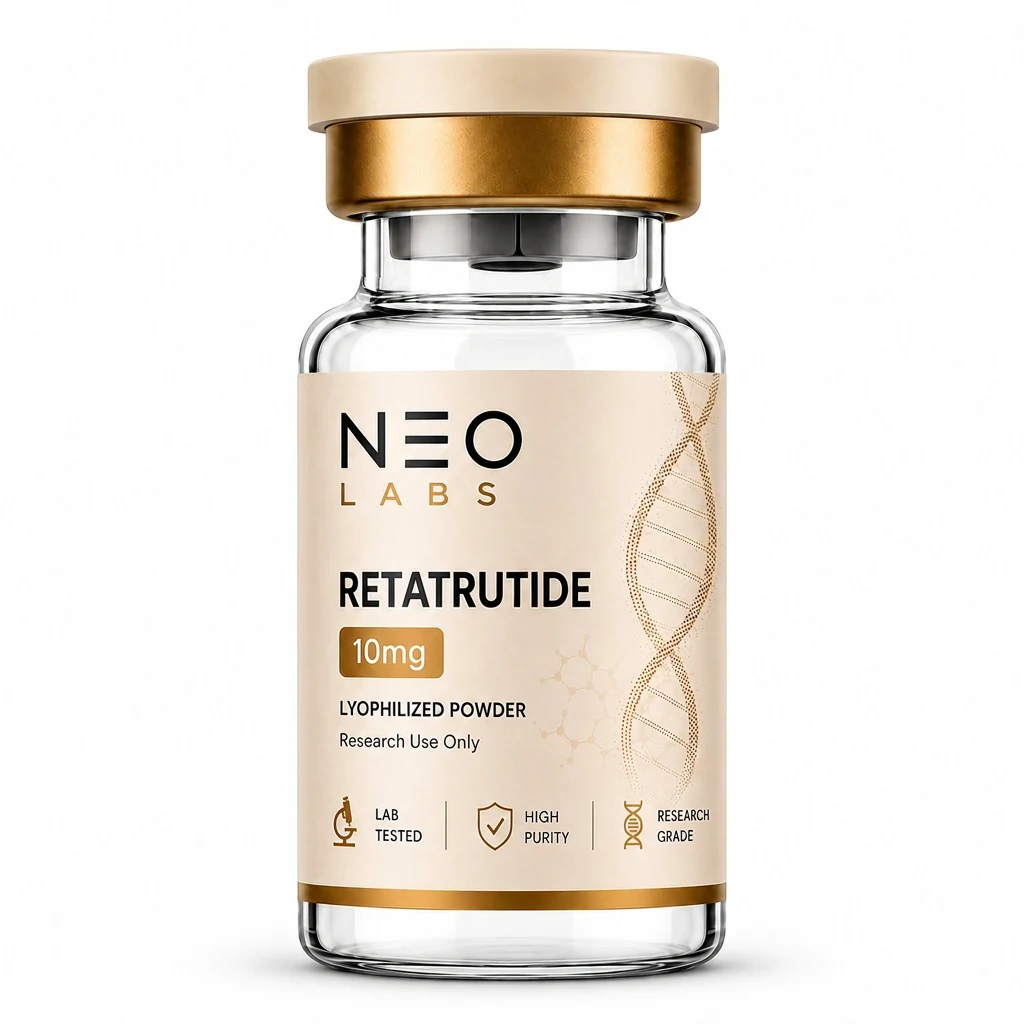
How is retatrutide classified?
Retatrutide belongs to the incretin-analogue family — synthetic peptides modelled on the gut hormones that signal through class B G-protein-coupled receptors. Structurally it is a GIP-based backbone modified with a fatty-acid side chain, a design used across this class to extend circulating half-life through albumin binding.
In classification tables it is grouped as a 'triple agonist' or 'tri-agonist', distinguishing it from single-agonist peptides (semaglutide) and dual agonists (tirzepatide).
How is its mechanism studied?
Published work examines retatrutide's signalling across three receptor arms:
- GLP-1 receptor activation, studied in insulin-secretion and gastric-motility models.
- GIP receptor activation, studied for its role in nutrient-dependent incretin signalling and adipose biology.
- Glucagon receptor activation, studied in hepatic energy-expenditure and lipid-handling models.
These statements describe how the published literature characterises receptor signalling. They are not claims about outcomes in humans and not a recommendation to administer the compound.
What kind of research exists?
The retatrutide record spans receptor pharmacology, rodent metabolic models and company-sponsored clinical trials reported in peer-reviewed journals from 2022 onward. Because a large share of the human data comes from a single development programme, reviewers routinely note the evidence base is young relative to older incretin peptides.
What is it studied alongside?
Comparative papers most often place retatrutide next to tirzepatide (dual GIP/GLP-1) and semaglutide (GLP-1 only), because the three form a natural receptor-coverage series. Grouping compounds this way describes how the literature organises them — it does not imply equivalence or any human-use indication.
How does Neo Labs supply and handle it?
Supplied as a lyophilised powder in a sealed vial, third-party HPLC-tested with a batch Certificate of Analysis available against the lot number. Store the sealed vial cold and protected from light, and treat reconstituted material as a short-life laboratory solution per your own lab's practice.