
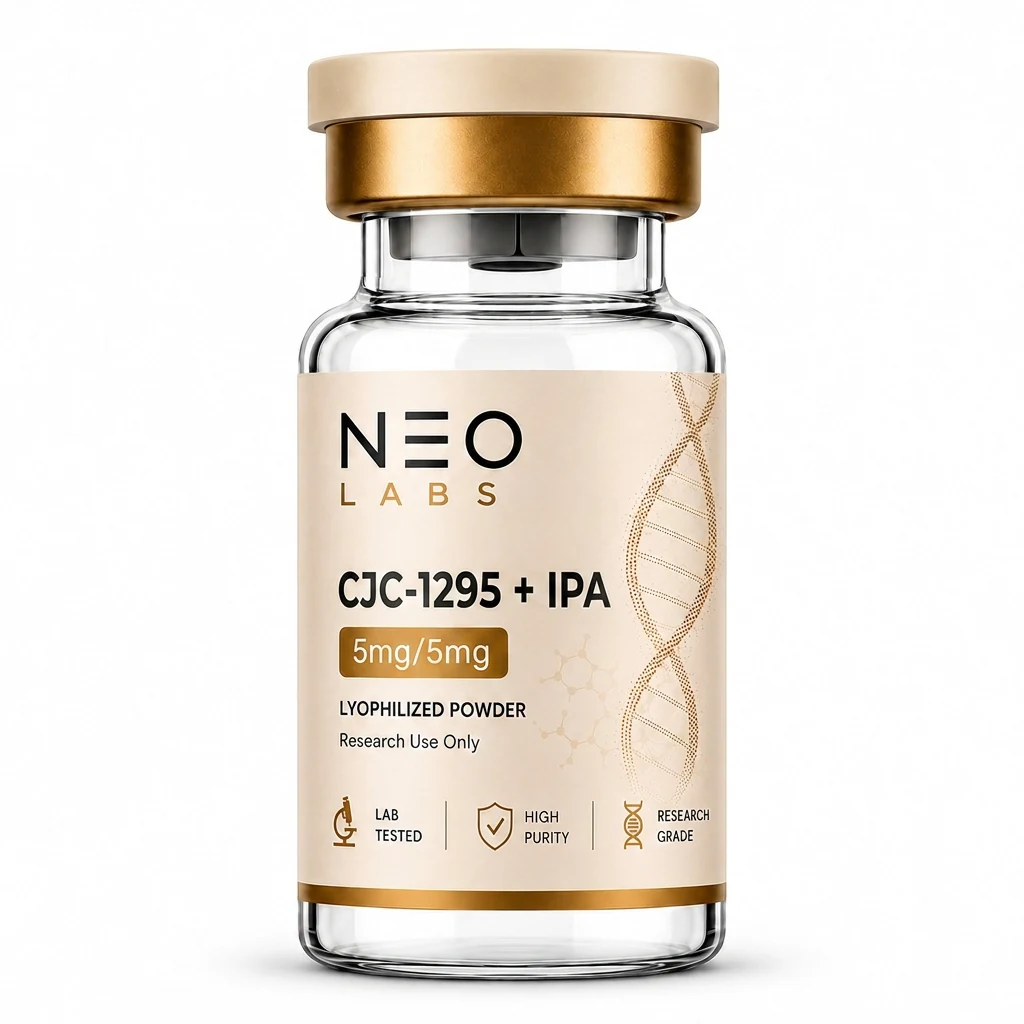
How are these compounds classified?
CJC-1295 is a GHRH(1-29) analogue with substitutions that resist enzymatic degradation; the 'no DAC' form omits the drug-affinity-complex modification and therefore has a shorter studied half-life. Ipamorelin is classed as a growth-hormone secretagogue, notable in the literature for its selectivity relative to earlier GHRPs.
How is the mechanism studied?
- GHRH receptor signalling on pituitary somatotrophs, studied for effects on GH pulse amplitude.
- GHS-R1a activation, studied as a separate secretagogue input to the same cells.
- Downstream IGF-1 readouts used as a study endpoint in animal models.
Descriptions of pulsatility and IGF-1 endpoints summarise study models. They are not human-use claims.
What kind of research exists?
GHRH analogue pharmacology is well established; ipamorelin has a defined receptor-selectivity literature from the late 1990s onward. Research on the specific combination is thinner and largely mechanistic, so combination-specific conclusions should be read cautiously.
What is it studied alongside?
Tesamorelin and sermorelin (other GHRH-family analogues), and GHRP-2 / GHRP-6 as earlier-generation secretagogues.
How does Neo Labs supply and handle it?
Supplied as a co-lyophilised research blend, third-party tested with a batch COA. Cold, dark storage.